| » print | » send via e-mail | Part of Equal-Life & Fotomatis Blogging Network

HIV / AIDS

Hasan Sadikin Hospital: Another Suspected Swine Flu A-H1N1 Patient Dies In Bandung

Swine Flu Suspect Patients
Patient U (21), who suspected was suffered an Influenza A-H1N1, has died at Hasan Sadikin Hospital (RSHS), Bandung, on Tuesday (18 / 8) night. The cause of his death is an inflammation of the lungs are aggravated by severe influenza A-H1N1 virus. The patient death cases suspected by influenza A-H1N1 in RSHS is the second incident.

"Samples of blood, lear of nose, and throat have sent to the Center of Research and Development Department of Health. However, we have not got the final results , "said Hasan Sadikin Hospital's Vice Chairman of the Special Infection Treatment Team, Primal Sudjana in Bandung on Wednesday.

He said, U were referred from the health center of Gunung Halu, West Bandung regency, with the condition suffer from inflammation of the lungs and immediately set as suspected influenza A-H1N1 on Tuesday at 11:45.

Based on information from relatives of victims, U had no contact with dead birds, pigs or another animals that could be spreading the virus. He previously was suffering from pneumonia. The last few days, several friends of the victims have suffered a mild flu.

When first arrived in RSHS, U's health condition is very bad. He suffered a bad cold, shortness of breath, and respiratory problems that must be installed ventilators and stabilizing blood pressure. However, it was not much help so U finally died on Tuesday at 20:45.

Previously, a patient suspected being infected of Swine Flu A-H1N1 Virus, with an initial S also died in RSHS last Monday. Until now the cause of the death is unknown. Provisional estimates, S died from pneumonia.

On the condition of the patient's suspected Swine Flu A-H1N1 with initial M (21) who treated the last 8 days, RSHS plan to return him. The reason, his health conditions has improved and the Symptoms Of Swine Flu A-H1N1 has disappeared. "Actually, his health condition has improved since yesterday and the plan he will be immediately returned.

700 Deaths Reported Worldwide Because Of Swine Flu H1N1 Virus

Swine Flu A H1N1 Virus PandemicData from the World Health Organization (WHO) says, Swine Flu H1N1 Virus has plucked more than 700 lives worldwide since the outbreak spreads last April. The amount dramatically increased since two weeks ago in which the number of victims who died there were as many as 429 people in more than 130 countries.

WHO calls all countries in the world take measures to minimize the spread of the virus A (H1N1), as dismiss school. "School closure is one of the mitigation measures that could be considered by countries," WHO spokeswoman Alphaluck Bhatiasevi told a news briefing.

Bhatiasevi states each country will face a different level from dangers of pandemic A (H1N1) Swine Flu Virus, including the time. Therefore, prevention step in a country will be different with another countries.

Previously WHO has asked each state to report the number of cases to WHO and to concentrate performing preventive steps to detect the spread of epidemics. WHO also asks all countries to ensure access to vaccines that most quickly will be available on the next September. Right now 125,000 laboratories have been confirms cases of Swine Flu A (H1N1) Virus in the world.

The agency, declared H1N1 Swine Influenza Virus Pandemic on June 11, and last week said it was the fastest-moving pandemic ever, and now pointless to count every case.

Swine Flu Anticipation In Indonesia Not Maximum

Swine Flu AnticipationUntil Wednesday (15 / 7), more than one hundred Indonesians expressed positive being infected of swine flu H1N1 virus. However, efforts to control the spread of swine flu by the Ministry of Health, particularly in international airports have not seen maximum. In Minangkabau International Airport, for example, Tools to detect body temperature or thermal scanner also has not been installed. Liability to use a mask does not followed yet.

In Medan, North Sumatra, Central Quarantine of Polonia Airport distributing free masks to every person in the airport. Every passengers came from overseas still required to go through the door of spraying body disinfectan. The passenger's body temperature reached 38 degrees Celsius must undergo an examination by medical teams who are standby at the airport.

According to WHO data, already 90 thousand cases of swine flu was reported in the world. As much as 429 of them died. WHO even has raised the pandemic alert level to phase six, the highest status of the pandemic of swine flu. However, in Indonesia, a vaccine for this disease will be available at the end of the year.

Please read also The H1N1 Virus Symptoms And How To Prevent And Treat Swine Flu Infection

Indonesian Citizen Need To Be Cautious On Swine Flu Infection From Foreign Countries

Swine Flu Pandemic42 Indonesian Citizen (WNI) known positive infected swine flu H1N1 abroad. Travel warning to foreign countries has not been determined, therefore Indonesian citizenz need to increase awareness and should be careful in the country of destination.

"A travel warning related to the pandemic or endemic disease will be determined after through several serious mechanisms under the coordination of Coordinating Minister for People's Welfare. So Foreign Affairs Department can not be undertaken this problem unilaterally," said spokesperson for the Ministry of Foreign Affairs Teuku Faizasyah.

It was delivered when Faizasyah confirmed by detikcom, through a short message that is sent on Sunday (12/7/2009). He added the case of swine flu that has been worldwide, including in Indonesia causing the infection potential is very high. Moreover, people can not be limited to travel.

"The most important thing is to keep cautious on the the visited country's status and maintain health," Faizasyah said who at this time is in Cairo, Egypt.

Previously Health Minister (Menkes) Siti Fadilah Supari said that there are 42 WNI positive infected with swine flu. From those 42, the 14 people infected swine flu in South Korea. They are group of singers from Indonesia following the Asian Choir Festival, in Changwon, Gyeongnam Province. Those 42 WNI is not allowed to return to Indonesia until declared negative of swine flu disease.

Please Read Also: Symptoms, Prevention And Treatment Of Swine Flu H1N1 Virus

H1N1 Virus Symptoms And How To Prevent And Treat Swine Flu Infection

H1N1 Virus Symptoms And How To Prevent And Treat Swine Flu Infection
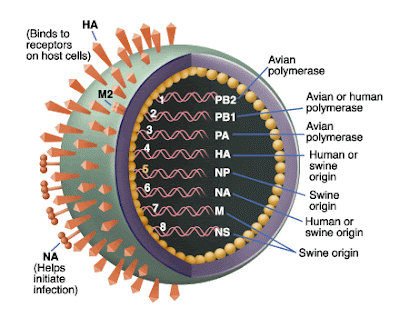
Swine Influenza or used to calls swine flu A H1N1, hog flu, and pig flu virus symptoms are the same as an ordinary influenza. Swine influenza virus H1N1 (SIV) is a new strain of the influenza family of viruses that is usually hosted by (is endemic in) pigs. Even swine flu H1N1 Virus reported to brings up a lot of extra fear and worry in world communities, the most important things to know, Swine Flu H1N1 Virus is just a common influenza with a new type of A H1N1 virus.

As of 2009, the known SIV strains are the influenza C virus and the subtypes of the influenza A virus known as H1N1, H1N2, H3N1, H3N2, and H2N3. Swine influenza is common in pigs in the midwestern United States (and occasionally in other states), Mexico, Canada, South America, Europe (including the United Kingdom, Sweden, and Italy), Kenya, Mainland China, Taiwan, Japan and other parts of eastern Asia.

Direct transmission of a swine flu virus from pigs to humans is occasionally possible (called zoonotic swine flu). In all, 50 cases are known to have occurred since the first report in medical literature in 1958, which have resulted in a total of six deaths. Of these six people, one was pregnant, one had leukemia, one had Hodgkin disease and two were known to be previously healthy. Despite these apparently low numbers of infections, the true rate of infection may be higher, since most cases only cause a very mild disease, and will probably never be reported or diagnosed.

Symptoms of Swine Flu H1N1 Virus


According to the Centers For Disease Control And Prevention (CDC), like the other types of flu, symptoms of swine flu infections can include:

* High fever
* Headache
* Chills
* Sore throat
* Cough
* Runny nose or stuffy nose
* Body aches
* Fatigue or tiredness, which can be extreme

The 2009 swine flu outbreak has shown an increasing percentage of patients reporting diarrhea and vomiting. However, the 2009 H1N1 virus is not zoonotic swine flu, as it is not transmitted from pigs to humans, but from person to person.

Signs of a more serious swine flu infection might include pneumonia and respiratory failure. If the flu becomes pandemic, potentially, everyone is at risk because few people, if any at all, will have immunity (resistance) to it.

If you experiencing one of these symptoms but a flu pandemic has not been announced yet, maybe you only have a common seasonal flu.

Prevention of Swine Flu

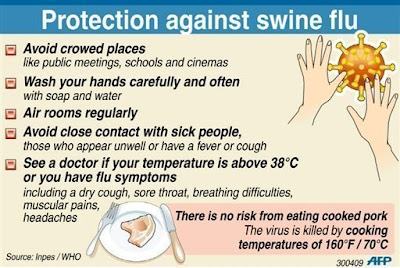
Influenza viruses usually spreads between humans through coughing or sneezing and when people touching materials with the virus on it and then touching their own nose or mouth. Swine flu virus cannot be spread by pork and its derivative products, since the virus is not transmitted through food. The swine flu virus in humans is most contagious during the first five days of the illness although some people, most commonly children, can remain contagious for up to ten days. Diagnosis can be made by sending a specimen, collected during the first five days for analysis.

Some recommendations to prevent the spread of the swine flu virus among humans include using standard infection control against influenza. This includes frequent washing of hands with soap and water or with alcohol-based hand sanitizers, especially after being out in public. Chance of transmission is also could be reduced by disinfecting household surfaces, which can be done effectively with a diluted chlorine bleach solution. Although the current trivalent influenza vaccine is unlikely to provide protection against the new 2009 H1N1 strain, vaccines against the new strain are being developed and could be ready as early as June 2009.

Health experts agree that washing our hand can help to prevent viral infections, including ordinary influenza and the swine flu virus. Influenza can spread in coughs or sneezes, but an increasing body of evidence shows small droplets containing the virus can linger on tabletops, telephones and other surfaces and be transferred via the fingers to the mouth, nose or eyes. Alcohol-based gel or foam hand sanitizers work well to destroy viruses and bacteria. Anyone with flu-like symptoms such as a sudden fever, cough or muscle aches should stay away from work or public transportation and should contact a doctor for advice.

Social distancing is another tactic. It means staying away from other people who might be infected and can include avoiding large gatherings, spreading out a little at work, or perhaps staying home and lying low if an infection is spreading in a community. Public health and other responsible authorities have action plans which may request or require social distancing actions depending on the severity of the outbreak.

Swine Flu Treatment

If anybody becomes sick and guessed being infected with swine flu, antiviral drugs can make the illness become milder and make the patient feel better faster. They may also prevent some serious flu complications would be occures.

For treatment, antiviral drugs work best if started soon after getting sick (within 2 days of symptoms). Beside antivirals, palliative care, at home or in hospital, focuses on controlling fevers and maintaining fluid balance.

The U.S. Centers for Disease Control and Prevention (CDC) recommends the use of Tamiflu (oseltamivir) or Relenza (zanamivir) for the treatment and/or prevention of infection with swine influenza viruses, however, the majority of people infected with the virus make a full recovery without requiring medical attention or antiviral drugs.


H1N1 Swine Flu Virus Pandemic Alert Level Raised To Phase Six

WHO raises H1N1 Virus Swine Flu Pandemic Alert Level From Phase Five To Phase SixWorld Health Organization (WHO) raises H1N1 swine flu Virus alert from the current phase 5 to phase 6, the highest alert level based on the WHO standard. WHO chief Dr. Margaret Chan made this announcement on thursday June 11, 2009, after an emergency meeting of the U.N. agency with International flu experts. Dr. Chan mentioned that they were moving the world pandemic level to phase 6 which means a virus pandemic, or global epidemic, is under way.

"This is an important and challenging day for all of us, The world is moving into the early days of its first influenza pandemic in the 21st century," Dr. Chan told reporters. "The swine flu (h1n1) virus is now not stoppable."

Increasing the alert level from the current phase 5 to Phase 6 does not mean that the disease is deadlier or more dangerous than before, just that it has spread to more countries, the WHO said.

The last previous pandemic occurred in 1968 which known as the Hong Kong flu and killed about 1 million people. Ordinary flu kills about 250,000 to 500,000 people each year.

On Thursday, WHO also said that 74 countries had reported there are 28,774 cases of swine flu (h1n1), including the fatal 144 deaths. Chan described this swine flu virus as "moderate." Based on pandemic criteria by WHO, a global outbreak has begun when a new flu virus begins spreading in two world regions.

Meanwhile, The U.N. Secretary General Ban Ki-moon said Thursday, Reactions to the World Health Organization's declaration of a flu pandemic must be grounded in science and avoid discrimination, vowing coordinated and effective U.N. action.

"We must guard against rash and discriminatory actions such as travel bans or trade restrictions," Ban told a news conference at U.N. headquarters.

Health experts consider the WHO's pandemic declaration did not mean that this H1N1 virus was getting deadlier and more dangerous. John Oxford, a professor of virology at St. Bart's and Royal London Hospital mentioned, "People might imagine a virus is now going to rush in and kill everyone, That's not going to happen."

But Prof. Oxford also said the swine flu virus might evolve into a more dangerous strain in the future. "That is always a possibility with influenza viruses," he said. "We have to watch very carefully to see what this virus does."

Introduction To Swine Flu (H1N1 Virus) Symptoms

Swine Flu, H1N1 Virus SymptomsThe swine flu symptoms are generally the same as an ordinary flu, but may be more severe and certainly can cause more serious complications. Although the name 'swine flu' brings up a lot of extra fear and worry in communities, the most important things to remember is that swine flu is just an influenza A H1N1 virus.

The typical symptoms are:

According to the CDC, like seasonal flu, symptoms of swine flu infections can include:

* High fever, but not the same like seasonal flu, is sometimes absent
* Headache
* Chills
* Sore throat
* Cough
* Runny nose or stuffy nose
* Body aches
* Fatigue or tiredness, which can be extreme
* Sometimes followed by Diarrhea and vomiting

Signs of a more serious swine flu infection might include pneumonia and respiratory failure. If the flu becomes pandemic, potentially, everyone is at risk because few people, if any at all, will have immunity (resistance) to it.

If you experiencing one of these symptoms but a flu pandemic has not been announced yet, maybe you only have a common seasonal flu.

See Also: How To Prevent And Treat Swine Flu Infection

WHO Raises Swine Flu Pandemic Alert Level From Phase Four To Phase Five

WHO Raises H1N1 Swine Flu Pandemic Alert Level Phase 4 to Phase 5World Health Organization (WHO) has raised the Swine Flu Pandemic alert level from the current phase four to phase five. Phase five alert means there are human-to-human transmission and widespread of human infections that happen in at least two countries.

This alteration emerge after a Mexican boy (23 month old) died in Texas recently. This death becomes the first swine flu death cases that happens outside Mexico, where the outbreak originated. This Mexican boy fell ill while visiting his family in southern Texas earlier this month. He died on Monday night at Texas Children's Hospital.

Margaret Chan, Director General of WHO Announced the latest pandemic alert phase in Geneva after WHO emergeny meeting, she also urged all countries world wide to activate their pandemic plans, including heightened surveillance and infection-control measures. She said that several actions should be undertaken with "increased urgency", "It really is the whole of humanity that is under threat in a pandemic."

According to Data from U.S. Centers for Disease Control and Prevention (CDC), Swine flu virus has spread to 11 states and infecting 94 people in the United States. Another five states is Nevada, Michigan, Massachusetts, Arizona and Maine, for now each of those states has at least one confirmed case.

Governments around the world including Indonesia are struggling to make containments to this deadly disease, however, no one is ready yet to call this outbreak as a full pandemic.

Swine Flu Pandemic Alert Level Raised By WHO

H1N1 Swine Flu Pandemic Alert Level Phase 3 to Phase 4 By WHOWorld Health Organization (WHO) mentioned that the swine flu category has been entering 'very worrying' phase. Dr Margaret Chan, Director General of WHO , on 27 April 2009 is recommending, from advices of the Committee, that all countries have to intensify surveillance for possibilities of the unusual outbreaks of influenza-like illness and severe pneumonia. And moreover, the Director General of WHO has raised the level of influenza pandemic alert level, from the current phase 3 to phase 4. This change to a higher phase of pandemic alert indicates that there are possibilities that the pandemic has increased, but this not mean that a swine flu pandemic is inevitable.

World health Organization meeting also requests all countries that have been infected by this disease to immediately overcome the problems. U.S also very concerned if the swine flu can be an endemic diseases.

The researchers are currently trying to overcome the spread of swine flu and also learning about how the virus can spread from human to human.

Given the widespread presence of the virus, the Director-General considered that containment of the outbreak is not feasible. The current focus should be on mitigation measures.

The Director-General recommending to all countries not to close borders and not to restrict international travel. It was considered prudent for people who are ill to delay international travel and for people developing symptoms following international travel to seek medical attention.

The Director-General considered that production of seasonal influenza vaccine should continue at this time, subject to re-evaluation as the situation evolves. WHO will facilitate the process needed to develop a vaccine effective against A/H1N1 virus.

The Director-General stressed that all measures should conform with the purpose and scope of the International Health Regulations.

In several days the disease has spread to the United States, Canada, Spain and Israel. Even last report mentioned that this virus has come to New Zealand, after 10 New Zealand students experienced symptoms of flue after returning from Mexico.

We all hope that the spread of Swine Flu viruses will not be up to Indonesia.

Directorate General of Animal Husbandry Preparations Towards Swine Flu Pandemic

Swine Flu H1N1 Pandemic Alet Level WHO, Direktur Jenderal Peternakan Departemen Pertanian
Mr. Tjeppy D. Soedjana as the Director General of Animal Husbandry, Ministry of Agriculture (Direktur Jenderal Peternakan Departemen Pertanian), ensures that for this time Indonesia perfectly safe from the spread of swine flu that is right now infecting Mexico and The United States of America.

There are a lot of reasons for it, but the main reason is because Indonesia does not have any trade relationships of pork and its derivative products from those two countries. "Hence, the spread of swine flu possibilities to Indonesia is very small,"said Tjeppy.

However,Ministry of Agriculture will be more cautious to this new endemic types with preparing various anticipations. Such as setting up rules and guidelines to respond every emergency situations, human resources, diagnostic lab infrastructures, and the quarantine.

Another Anticipating form such as controling the livestock will also be conducts by the Technical Executive Unit (Unit Pelaksana Teknis)from Directorate General of Animal Husbandry, including giving special attentions to foreign tourists from the United States and Mexico by the Ministry of Agriculture Quarantine Agency. "Because they can act as a carrier of diseases," said Cheppy.

Directorate General of Animal Husbandry has formed a team to conduct meetings and coordinate the anticipation with Directorate General for Disease Control and Environment Sanitation, Department of Health and National Quarantine related to the outbreaks. "Because, in the case of Indonesia, pigs can also be contagious avian influenza (bird flu)," said Tjeppy.

Recent Posts

Swine Flu Prevention

Benefits of Flavonoid

Health And Beauty

Diabetes Mellitus

Cancer Treatment Facts

Hormone Therapy & Ovarian Cancer Risks A study from Rigshospitalet, Copenhagen University in Denmark strengthens the statement that hormone therapy in close relation with the increased risk of cancer.
Phyto Stem Cell Helps To Prevent Aging Phyto Stem Cell protecting, re-activate skin cells that has been damaged by the bad effects of the skin aging process, sun exposure and UV rays, and other external factors.
Acne And Comedo Home Treatment The main query here is which treatments will work the best to cure acne and blackheads? Here are number of the techniques and measures to cure blackheads with ease:
All information provided in Absolute Healthy Advisory is for an informational purposes only,
and should not be
relied upon as a substitute for consultation with a medical doctor or other healthcare provider.